Solving Radical Equations
By M Ransom
🖶 Printer-friendly versionWe examine ways to solve equations such as
 .
.
In solving any equation, we always “undo” the operation so that we can get x isolated. In this case we have to square both sides of the equation. The examples cited below describe some of the methods needed to solve equations which include radicals.
#1. To solve

we first square both sides of the equation.
The result is x - 2 = 81. This equation is simple to solve. We have x = 83.
#2. A more complicated situation is
 .
.
In this case we still begin by squaring both sides of the equation. The result is
.
To finish solving this requires us to set all terms equal to zero and either factor or use the quadratic formula. We get
.
This factors:
and the solutions are x = 2 or x = - 1.
We must check each of these solutions in the original equation to see if the value of x gives a solution.
x = 2 gives
which is correct.
x = - 1 gives
which is impossible since
for n > 0 is always positive.
Therefore the only solution is x = 2.




Keeping in mind the basic idea of squaring both sides of the equation in order to solve for x when there is a radical in the equation, we will now show some additional examples.
#3. Solve for x if
 .
.
Squaring both sides of the equation gives us
.
Setting terms equal to zero gives
.
The expression factors:
.
Setting each factor equal to 0 gives two possible answers: x = 3 or x = – 1.
We check each answer in the original equation:
If x = 3 we have
which is correct.
If x = – 1 we have
which is impossible since the square root cannot be negative.
Therefore the only answer is x = 3.


#4. Suppose
 .
.
We begin again by squaring both sides of the equation. The result is 3x – 2 = x + 7.
We solve for x getting 2x = 9 or
.
We check this possible answer in the original equation.
If
we have
.
This is the same as
which is correct.
Therefore the solution is
.


#5. Solve for x if
 .
.
We square both sides. This gives x + 2 = 2 – x.
Solving for x gives 2x = 0. The only solution is x = 0.
Checking this in the original equation gives
which is correct.
Therefore the solution is x = 0.

#6. Let
 .
.
Our first step is to separate the radicals. The result is
.
Now we square both sides. The result is
.
We next isolate the radical term on the right side. The result is
.
We square both sides again. The result is
.
We set the terms equal to zero. The result is
.
We solve this by factoring or using the quadratic formula. This does factor: (x – 5)(x + 3) = 0. This gives two possible solutions: x = 5 or x = – 3.
We check these possible solutions in the original equation.
If x = 5 we have
. This is the same as 4 – 3 = 1.
If x = – 3 we have
.
This is impossible since
.
Therefore the only solution is x = 5.
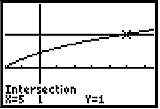
Another way to obtain the same result in example #6 is by using the Intersect feature on a graphing calculator. The graphs of Y1=

and Y2 = 1 are shown below intersecting where x = 5.




Advertisement