Word Lesson: Area and Perimeter of Rectangles
By M Ransom
🖶 Printer-friendly versionIn order to solve problems which require application of the area and perimeter for rectangles, it is necessary to
- use basic formulas for area and perimeter of a rectangle. The area is lw where l is the length of the rectangle and w is the width. The perimeter is 2w + 2l.
- solve basic linear and quadratic equations.
- use the Pythagorean Theorem in finding the length, width, and diagonal of a rectangle.
A typical problem involving the area and perimeter of a rectangle gives us the area, perimeter and/or length and width of the rectangle. We may also be given a relationship between the area and perimeter or between the length and width of the rectangle. We need to calculate some of these quantities given information about the others.
Suppose the length of a rectangle equals twice its width and its area is 32. Find the dimensions of this rectangle and its perimeter.
To get started, relate the length and width. We know that the length is twice the width sol = 2wWe know the area is 32, so we use the area formula for a rectangle:lw = 2w(w) = 2w2 = 32
Solving for w:
2w2 = 32
w2 = 16
w = 4The length equalsl = 2w
l = 8and the dimensions are 8 x 4.The perimeter is the sum of the lengths of all four sides or2w + 2l = 2(4) + 2(8) = 24
 Suppose that the perimeter of a rectangle is 36 and the length is twice the width. What are the dimensions of this rectangle and what is the area?
As shown in the following diagram, a rectangle's length is 2x + 1 and its width is 2x – 1. If its area is 15 cm2, what are the rectangle's dimensions and what is its perimeter? 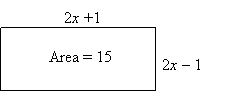
A rectangle has a length of 8 and a diagonal of 10. What are the area and perimeter of this rectangle?
A rectangle has a length that is 2 less than 3 times the width. If the area of this rectangle is 16, find the dimensions and the perimeter.
- length = 4 and width = 2 and the perimeter is 12
- There is no solution. The solution involves the square root of negative 1.
- length = 6 and width = 8/3 and the perimeter is 52/3
A rectangle is shown in the diagram below. If the area is 105, what are the rectangle's dimensions and what is its perimeter?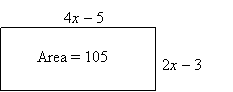
- length = 4 and width = 1.5 and the perimeter is 11
- length = 15 and width = 7 and the perimeter is 44
- There is no solution. The solution involves the square root of negative 1.
A rectangle has a diagonal which is 3 times the width. If the area is  what are the width and perimeter of this rectangle?
- width = 2 and the perimeter is

- width =
and the perimeter is

- width =
and the perimeter is

This type of problem involves relationships between the length and width and/or connections between the length, width, and diagonal of a rectangle. With information about the area or perimeter, we can set up equations that allow us to find the rectangle's length and width. Once these are known, we can use the formulas for area and perimeter.
Sometimes there is a need to use the Pythagorean Theorem to relate the length, width, and diagonal. It is important to take note of the fact that the diagonal is always the hypotenuse of this right triangle.
Sometimes there is a quadratic equation involved. You can use the quadratic formula to either solve the equation if it does not factor nicely or to check your work.
Advertisement