Degree and Radian Measurement of Angles
By M Ransom
🖶 Printer-friendly versionIntroduction: In this lesson, two different ways to measure angles will be examined. A comparison of these methods will be shown as well as supporting illustrations drawn in a coordinate plane.
The Lesson:
Let's Practice:We begin with two basic measurements followed by two fundamental definitions.
- Once around a circle is 360º.
- The circumference of a circle with radius 1 is
.
Degree measure of angle is based upon the number of degrees in a circle while radian measurements are based on a different method of describing a complete circle. Radian measure of an angle is the length of the arc intercepted on a circle of radius 1 by an angle in standard position on a coordinate plane. Or equivalently, the radian measure of a central angle in standard position on a coordinate plane is the ratio of the intercepted arc length to the radius of the circle.
Using the fact that 360º corresponds to
radians, we can generate the following angle measures:
- Dividing by 2 gives 180º which corresponds to

- Dividing again by 2 gives 90º corresponds to

- Dividing by 3 gives 60º which corresponds to

- Dividing by 4 gives 45º which corresponds to

- Similarly, dividing 60º by 2 gives 30º which corresponds to

- Other radian measures of angle can be found for such angles as 150º or 240º or -135º because they are multiples of 30º, 45º, and 60º. For example, since we know that 30º corresponds to
we can convert 150º to
since
.
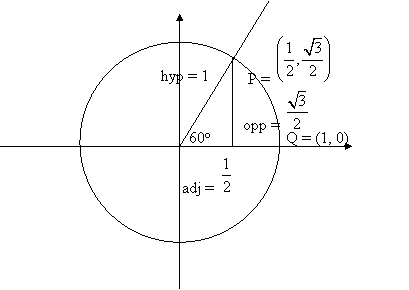
A diagram is shown below of a circle with radius 1 and an angle of 60º in standard position. P is the point where the angle intersects the circle and is
. Q is the point on the horizontal axis given by (1, 0). We have already shown that 60º corresponds to
in radian measure. This is the exact measure of the arc from P to Q. Remember that the radian measure of an angle is the length of this arc on a circle of radius 1.
We can generalize the correspondence between degree and radian measure since we know that 180º corresponds to
radians. Using an equal sign to describe this relationship (the radians and degrees are not actually “equal” measurements) we can write:
We can use these ratios to convert radian measure into degrees and vice versa.




What is 70º in radians?
To change this degree measurement to radians, we multiply as follows:

What is 2 radians in degrees?
To change this radian measurement to degrees, we multiply:

What is

radians in degrees?
To change this radian measurement to degrees, we multiply:

What is 270º in radians?
What is -172º in radians?
What is  radians in degrees?
What is -0.6 radians in degrees?
Advertisement