Continuity and Discontinuity
By K Dodd
🖶 Printer-friendly versionLet's begin with the piecewise function f(x) described below.
f(x) = {
x + 1, x < 2
k(x - 5)2, x ≥ 2
Initially, let k = 1.
f(x) = {
x + 1, x < 2
1(x - 5)2, x ≥2
To sketch a piecewise function, begin with a table.
x f(x) 0 1 1 2 2 3 (open) 2 9 (closed) 3 8 4 7
Recall that we let x = 2 be included both above and below the dotted line in our table because 2 is present in both domain conditions.
Since all of the x- and y-axis values are positive, this function will be primarily graphed in the 1st quadrant.
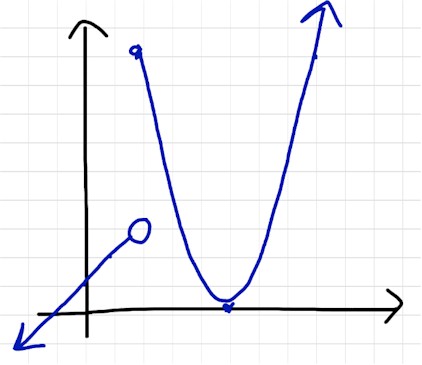
Examining the graph you can see that on the
Left piece there is an open circle at (2, 3) and an arrow points down and left.
Right piece there is a closed point at (2, 9), vertex at (5, 0), symmetric point (8, 9) with an arrow pointing up and to the right.
The next question is to show that this function is discontinuous at 2.
Looking at the limit as x → 2 you can see that limit as x → 2- (from the left) equals 3 while the limit as x → 2+ (from the right) equals 9. Since 3 ≠ 9. Therefore, f(x) is discontinuous at 2.
But what if the value of k was not specified? Then the limit as x → 2- (from the left) stills equals 3, but the limit as x → 2+ (from the right) now equals 9k.
Consequently, if you want f(x) to be continuous at x = 2 then the two limits must be equal to each other, 3 = 9x. Solving gives you k = 1/3.
Re-graphing when k = 1/3, we would get a cusp at x = 2. Remember that a cusp is an abrupt change in the slope in a function. It is sometimes referred to as a corner.
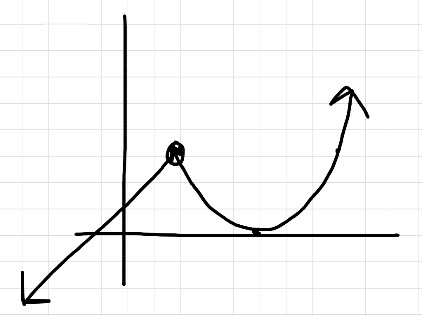
How would you answer this question: "Is your function increasing or decreasing at x = 2?" Well, it is doing both - increasing on the left and decreasing on the right. That would mean that f(x) may be continuous, but not differentiable, at x = 2, due to the abrupt change in the slope.
In Calculus, we have a very strict 3-part definition of continuity. If a function is continuous, you need to address that it meets all three parts of the definition. If a function is not continuous, you have to specifically detail which one of the 3 parts of the definition is not met.
Continuity Discontinuity
- Suppose that you have a rational function which you can factor and reduce. You recall that we called that a point a "removable discontinuity" and that particular point would not be on the graph, instead an open circle would be at its position.
① f(c) must exist
Recall the behavior of piecewise functions. There can be open circle(s) and closed circle(s). In this instance the function in not continuous because the lim x → c is not defined.
② limit as x → c of f(x) exists
limit as x → c- (from the left) must equal the same value as the limit as x → c+ (from the right)
Suppose that you given a function where when x = c there is an open circle in the function's graph, but the value of f(c) is arbitrarily defined elsewhere. Then f(x) would not be continuous at x = c.
③ f(c) = limit as x → c of f(x)
The three general types of discontinuities are:
① Type 1: removable discontinuity
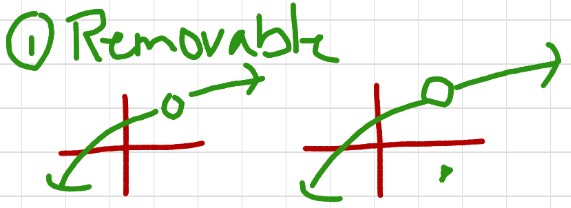
As seen in the picture, one type of removable discontinuity is for the point to be "missing" and no where to be found. The second type is when the point is taken out of the main part of the function but is defined somewhere else.
② Type 2: step/jump
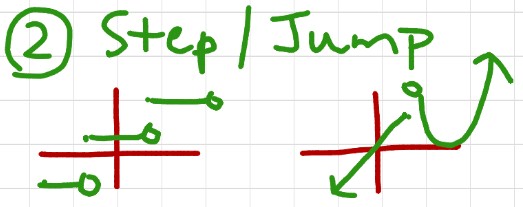
As seen in the picture, one type is the "step function" where one end of a horizontal line is open and the other is clased. The second type is a jump where the graph rapidly changes to a new position. Both pass the vertical line test.
③ Type 3: infinite discontinuity-vertical asymptotestep/jump
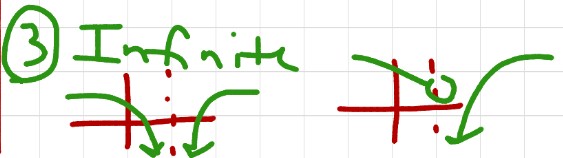
Notice that on both sides of the asymptote, the graph can be approaching infinity in the same (or opposite) direction(s) or just one side can be approaching inifinty.
Remember that a relation is a function if and only if it passes the vertical line test - each value of the domain, x, can only be mapped to one specific value of the range, y. This often leads to a restriction being placed on the domain, or acceptable values for x.
Advertisement